If you are comparing Bluffview and Devonshire, the house style is only part of the story. In these two Dallas neighborhoods, the land beneath the home often shapes how the property looks, lives, and holds long-term appeal. When you understand the lot first, the architecture starts to make much more sense. Let’s dive in.
Why lot style matters first
In both neighborhoods, buyers are often drawn in by curb appeal, but the lot is what drives day-to-day livability. The shape of the land, the tree canopy, the setbacks, and the way a home sits on the site can influence privacy, light, views, and future flexibility.
That is especially true in Bluffview and Devonshire because they were shaped by very different planning patterns. One neighborhood follows the land. The other follows a more compact, established street rhythm.
Bluffview lot styles
Bluffview grew around the terrain
Bluffview Estates opened in 1924 on what had been a 215-acre dairy farm. The neighborhood was laid out around Bachman Creek, a 60-foot Austin Chalk bluff, and mature trees, which is why it developed winding streets and many odd-shaped lots instead of a strict grid.
That history still defines the neighborhood today. In Bluffview, the land itself is often the headline feature, not just the home sitting on it.
Bluffview lots feel estate-like
Bluffview is known for larger, more dramatic lots. Some sites are shaped by bluff edges, creek adjacency, down-sloping topography, or dense mature canopy, which creates a more estate-like setting than you typically find in more uniform Dallas neighborhoods.
Because of that, two homes on the same street can feel very different from one another. A lot with bluff views or a stronger tree backdrop may offer a very different experience than a flatter interior lot, even if the square footage is similar.
Bluffview is highly site-driven
For buyers and sellers, Bluffview value tends to be heavily site-driven. Important variables include bluff views, creek proximity, lot shape, mature trees, and how well the house is positioned into the land.
This is one reason Bluffview often attracts custom thinking. The strongest homes here usually feel tailored to their setting rather than dropped onto a lot with a formula.
Bluffview architecture styles
Architecture is varied, not one-note
Bluffview is not defined by a single architectural style. Over time, it has attracted architect-driven homes as well as Tudor, modern, midcentury, and extensively renovated properties.
That range is part of the neighborhood’s appeal. You are less likely to see a repetitive streetscape and more likely to see homes that respond to topography, privacy, and mature landscaping in different ways.
Architect-driven homes stand out
The neighborhood includes work associated with Charles Dilbeck and O'Neil Ford, which helps explain Bluffview’s design reputation. Research examples show the contrast clearly, from a 1935 Dilbeck on a 1.25-acre lot to a 2017 contemporary on Pomona Road that uses setbacks, glass, and simple massing to preserve privacy.
What ties these homes together is not one style label. It is a shared response to the site.
What buyers should notice in Bluffview
When you tour Bluffview, pay attention to more than the finish-out. Look closely at:
- How the home meets the grade
- Whether the lot slopes or terraces
- The relationship between the house and the tree canopy
- Privacy from the street and neighboring homes
- Whether the design takes advantage of views or natural features
In Bluffview, a well-sited home often matters as much as the style itself.
Devonshire lot styles
Devonshire is more compact and regular
Devonshire offers a different lot story. The neighborhood is known for tree-lined streets, mature shade trees, and lots that are generally more uniform, compact, and well maintained.
A current neighborhood guide places the median lot size at 9,147 square feet. That helps explain why scale, setbacks, and massing are such important parts of the conversation in Devonshire.
Devonshire lots are easier to read
Compared with Bluffview, Devonshire lots are generally easier to imagine for renovation or infill. They tend to be more regular in shape, which creates more conventional planning for additions, rebuilds, and updated outdoor space.
That does not mean the lots are interchangeable. It means the design challenge is usually more about proportion and fit than dramatic topography.
Street rhythm matters in Devonshire
In Devonshire, the feel of the block plays a major role in property appeal. Because lots are more compact and the streets are strongly defined by mature trees and established setbacks, homes tend to work best when they respect the neighborhood’s existing rhythm.
That is often the key difference between a house that feels at home on the street and one that feels oversized for its setting.
Devonshire architecture styles
Original character still shapes the neighborhood
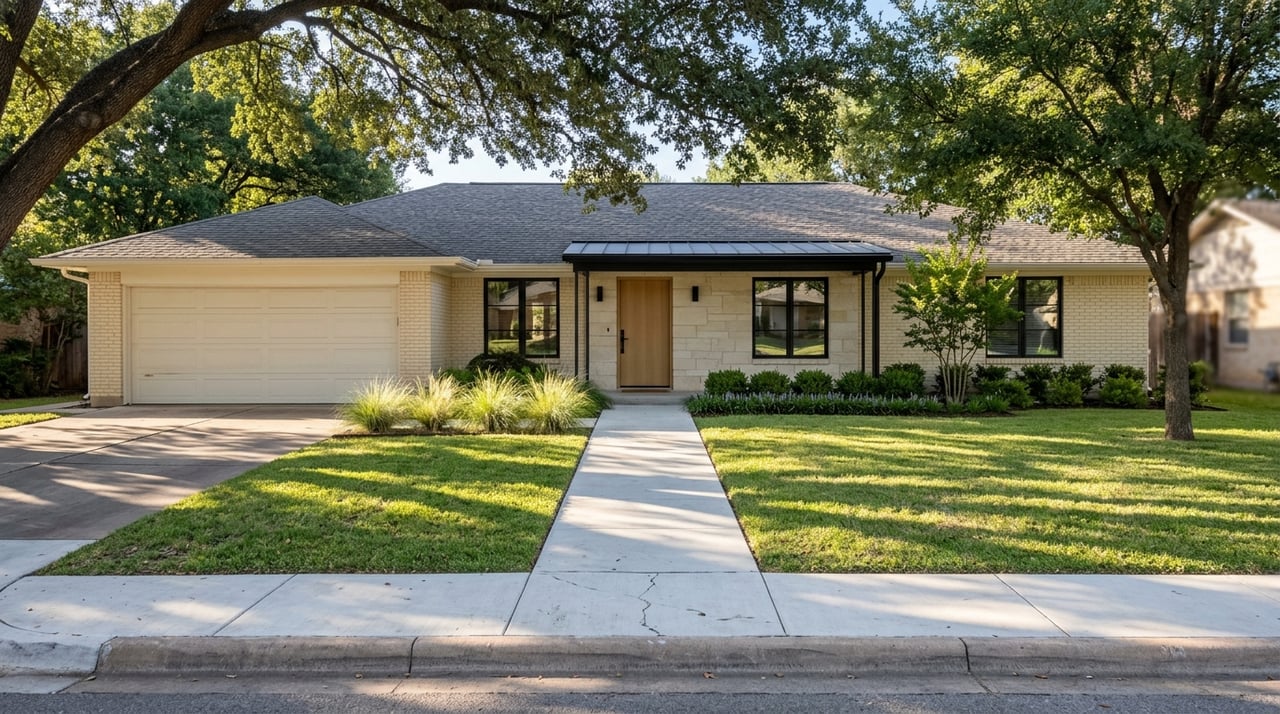
Devonshire has a broad architectural mix, but ranch homes, bungalows, and midcentury houses remain central to its identity. Older neighborhood coverage described the area as dominated by those forms, while more recent reporting points to a wider blend of Craftsman-influenced bungalows, Tudor Revival, Colonial Revival, renovated originals, and newer contemporary custom homes.
That layered mix gives Devonshire flexibility. You can see both preserved character and modern interpretation within the same neighborhood.
Newer homes continue to expand the mix
Recent examples in reporting include a 2020 contemporary on a quarter-acre lot, a 2022 custom contemporary on a quarter-acre, a 2023 Cotswold-modern hybrid on 1.44 acres by a creek, and a 2026 custom modern on a half-acre.
Even with that variety, Devonshire still tends to read as more consistent at the street level than Bluffview. The lots, tree canopy, and neighborhood pattern help hold the area together.
What buyers should notice in Devonshire
When evaluating homes in Devonshire, focus on how the house fits the lot and the block. Key things to watch include:
- Setback consistency with nearby homes
- Overall massing on a compact lot
- Tree preservation and canopy impact
- Whether an addition or new build feels balanced on the site
- How outdoor space is divided between front, side, and back yard areas
In Devonshire, success often comes from scale and restraint rather than dramatic site features.
Bluffview vs. Devonshire
The biggest lot difference
If you want larger and more dramatic lots, Bluffview usually stands out. Its identity is tied to land form, creek edges, bluff conditions, and irregular parcels shaped by the natural landscape.
If you prefer more uniform lots that are simpler to picture for a remodel or new build, Devonshire often feels more straightforward. The lots are generally smaller and more regular, with more predictable infill potential.
The biggest architecture difference
Bluffview tends to feel more estate-like and architect-driven. Devonshire tends to lean more toward bungalow, ranch, midcentury, and newer transitional or contemporary homes that fit into a compact, tree-lined setting.
Neither neighborhood is one-style-only. The difference is how much the site drives the design language.
The best way to evaluate either one
In both neighborhoods, lot quality and siting matter as much as interior finishes. A beautiful kitchen can be updated. A special site, strong street presence, or a home that sits naturally on the land is much harder to replicate.
That is why the smartest comparisons usually start outside. Before you focus on countertops or lighting, look at the lot, the block, the trees, and the way the house belongs to its setting.
How this helps buyers and sellers
For buyers
If you are deciding between Bluffview and Devonshire, this lens can help you narrow the search faster. Bluffview may appeal more if you want dramatic land, privacy, and architecture shaped by the site. Devonshire may appeal more if you want a classic Dallas neighborhood feel with more compact lots and a strong renovation or rebuild story.
The right fit depends on what matters most in your daily life. Lot shape, privacy, scale, and block character can all affect how a home feels long after the tour is over.
For sellers
If you own in either neighborhood, your home’s value story should go beyond finishes and bedroom count. In Bluffview, the setting itself may be one of the property’s most important assets. In Devonshire, the way the home fits the street and lot may be central to its appeal.
That kind of positioning requires more than standard listing language. It calls for clear neighborhood storytelling, strong presentation, and a marketing strategy that highlights what makes your site and architecture stand out.
If you are thinking about buying or selling in Bluffview or Devonshire, The Rosen Group brings the kind of Dallas neighborhood insight, presentation strategy, and principal-led guidance that helps you evaluate the details that truly drive value.
FAQs
What makes Bluffview lots different from Devonshire lots?
- Bluffview lots are generally more dramatic and shaped by topography, creek features, bluff conditions, and irregular parcel lines, while Devonshire lots are typically more compact, regular, and easier to picture for renovation or infill.
What architecture styles are common in Bluffview?
- Bluffview includes a mix of architect-driven homes, Tudor, modern, midcentury, and renovated properties, with many homes designed to respond directly to the terrain and tree canopy.
What architecture styles are common in Devonshire?
- Devonshire is commonly associated with bungalows, ranch homes, midcentury houses, Craftsman-influenced bungalows, Tudor Revival, Colonial Revival, renovated originals, and newer contemporary custom homes.
Why does lot siting matter in Bluffview and Devonshire?
- In both neighborhoods, siting affects privacy, views, light, curb appeal, and long-term usability, so buyers and sellers should evaluate how well the home fits the land and the street, not just the interior finishes.
Is Bluffview or Devonshire better for new construction or remodeling?
- Bluffview often rewards custom design that responds to the land, while Devonshire is generally more redevelopment-friendly because its lots are more regular and the design challenge is often about matching the existing street scale and tree-lined character.