"You need off markets."
That was Dallas builder Harrison Polsky's answer when CandysDirt.com founder Candy Evans read off the numbers on an episode of the Dallas Express podcast Let's Talk Local, recorded in early 2025. Evans had cited year-end 2024 MLS figures showing home sales in Bluffview and neighboring Greenway Park down roughly 10 percent in volume, with the median sale price down about 8 percent. On paper, that reads like a neighborhood cooling off. Polsky, who builds and sells luxury spec homes across North Dallas as principal of Catena Homes, pushed back immediately. The public numbers were missing the deals that never touched a listing sheet.
He wasn't being evasive. He was describing how Bluffview's market actually works, and why anyone comparing it to the Park Cities or Preston Hollow off a portal median is reading an instrument that can't see half the picture.
The Numbers That Started the Argument
Evans wasn't wrong about what the MLS showed. Fewer homes traded hands in Bluffview through the end of 2024 compared to the year before, and the median closing price came in lower. If you were watching that one data point, the story looked like softening demand, maybe buyers pulling back, maybe sellers holding firm on price and losing the negotiation.
That reading makes sense if you assume Bluffview behaves like a normal, high-volume suburban market where enough transactions happen every month to smooth out the noise. It doesn't. Bluffview is a small, geographically distinct pocket of North Dallas, roughly a thousand homes total, sitting west of the Dallas North Tollway along the Inwood Road corridor, built on rolling terrain along Bachman Creek that dates back to the neighborhood's origins as dairy farmland. A market that size doesn't generate enough closings in any given month for a median to mean much. A handful of transactions, or the absence of them, can swing the number in either direction without reflecting anything structural about value.
Why Texas Makes That Data Blind
Here's the part that doesn't get said out loud often enough. Texas is a non-disclosure state. Sale prices on private transactions, particularly land and off-market deals between builders and sellers, don't have to be reported publicly the way they do in disclosure states. When Polsky told Evans "you need off markets" to understand what was really happening, he meant that a meaningful share of the price action in a neighborhood like Bluffview happens in deals that simply never generate a public comp.
That matters most for land, not finished homes. A median sale price calculated from MLS closings is built almost entirely from homes that were listed and sold through traditional channels. It says nothing about what a builder just paid a landowner directly for a teardown lot, because that transaction may never appear in the dataset at all, or may appear months later folded into a much larger, unrelated home sale once construction finishes. If land is where the real repricing is happening, and land deals are the ones most likely to go unreported, the public median can look flat or falling in the exact window where the ground underneath it is moving fast.
What Was Happening Off the Books
While the year-end 2024 numbers were showing a soft Bluffview, Catena Homes was buying a lot in the neighborhood off market for $1.9 million in October 2024. Within months, a similarly sized homesite came to market and sold for $2.6 million after listing at $2.2 million, according to Polsky's account in reporting from The Real Deal. That is close to a 37 percent jump in land value inside a matter of months, on a comparable lot, in the same neighborhood where the public data said things were cooling.
Here's how that timeline lines up:
| When | What happened | Price |
|---|---|---|
| October 2024 | Catena Homes buys a Bluffview lot off market | $1.9 million |
| Months later | A comparable Bluffview homesite lists | $2.2 million |
| Months later | That homesite sells | $2.6 million |
| 2026 | Catena completes a spec home on the original lot | Lists at $6.8 million |
None of the land transactions in that first three rows would have shown up as a "home sale" in a median price calculation. They're dirt, not houses. The only place that price signal becomes visible to the public is at the end, once a finished home carrying that land cost hits the market.
The House That Bet on the Land
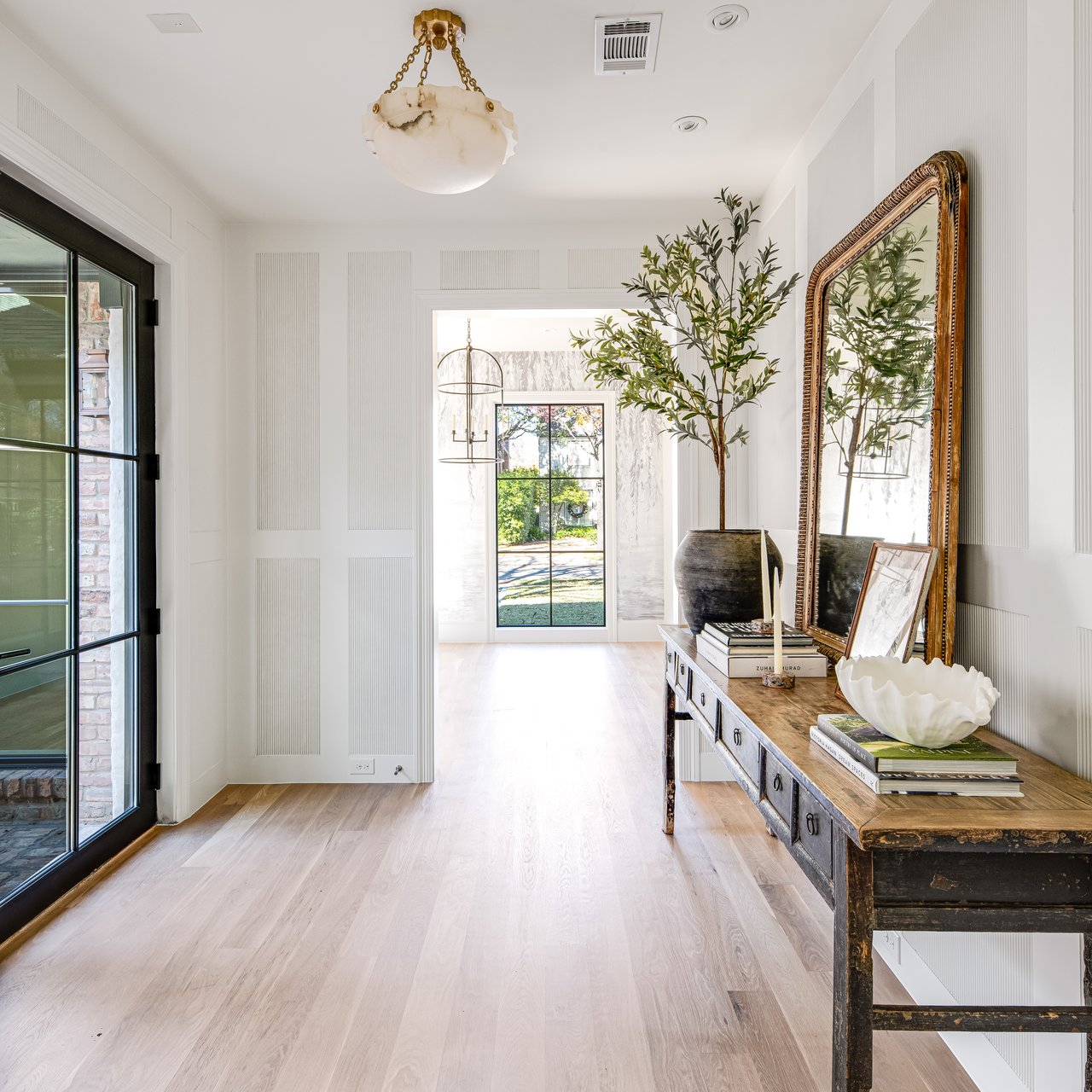
That finished home is now on the market. Catena Homes built a 7,000-square-foot, six-bedroom, nine-bathroom residence at 4405 Wildwood Road, known as The Elysian, designed with Briggs & Associates and finished with interiors by Matt Mazur. It's listed at $6.8 million, or about $956 per square foot, making it the most expensive new home in Bluffview, according to The Real Deal's reporting on the listing.
Polsky's stated logic isn't complicated. Teardowns and rebuilds have been standard practice in the Park Cities for years, where land is scarce and buyers pay a premium for a walkable lot regardless of what's sitting on it. Bluffview has been the more affordable alternative next door, with the same proximity to Love Field, Inwood Village, and the private schools that draw Park Cities buyers in the first place. Polsky is betting that continued relocation into Dallas, particularly from higher-cost coastal markets, closes that gap faster than the public data suggests. Dallas-Fort Worth netted eleven new corporate headquarters in 2025, per CBRE data cited in that same reporting, and that kind of employer relocation tends to bring buyers who are comparing Dallas neighborhoods against what they're used to paying elsewhere, not against last year's Bluffview median.
Whether $956 a square foot holds for that specific house remains to be seen. What's already confirmed is the land trade that got Catena there, and that trade happened in the same window the MLS said the neighborhood was going soft.
What This Means If You're Comparing Bluffview to the Park Cities
If you're weighing Bluffview against Highland Park, University Park, or Preston Hollow, the headline median on any portal is telling you less than it appears to. In a market this small and this land-driven, here's what actually carries signal:
- Recent lot sales and teardown activity, not finished-home comps, since land is where price discovery happens first
- Who's building there right now and what they're willing to pay for dirt, since builders have visibility into deals that never reach MLS
- The gap between a neighborhood's land cost and its finished-home pricing, since a widening gap usually means the market hasn't caught up to what builders already know
- Whether a given comp is a renovated original cottage from the neighborhood's 1930s-1950s core or new construction on a rebuilt lot, since those are functionally different products wearing the same zip code
None of that means Bluffview is guaranteed to close the distance to Park Cities pricing. Polsky himself was careful to separate his bet on trophy product from his expectations for the broader market, noting that mid-tier and lower-tier inventory across Dallas-Fort Worth has been sitting for 90 to 120 days and selling 5 to 7 percent under list even as top product commands record pricing. The lesson isn't that every Bluffview lot is about to jump 37 percent. It's that a median built from thin, non-disclosed data can't tell you which is which, and the only way to know is to look at what's actually trading underneath it.
If you're sizing up Bluffview against the Park Cities, or trying to figure out what a specific lot is really worth before you write an offer or list one, The Rosen Group can walk you through the land comps and off-market activity a portal median will never show you. Request a private consultation and home valuation to get the full picture before you make a move.